
Shadow Fight 2 Nintendo Switch All Characters Strategy
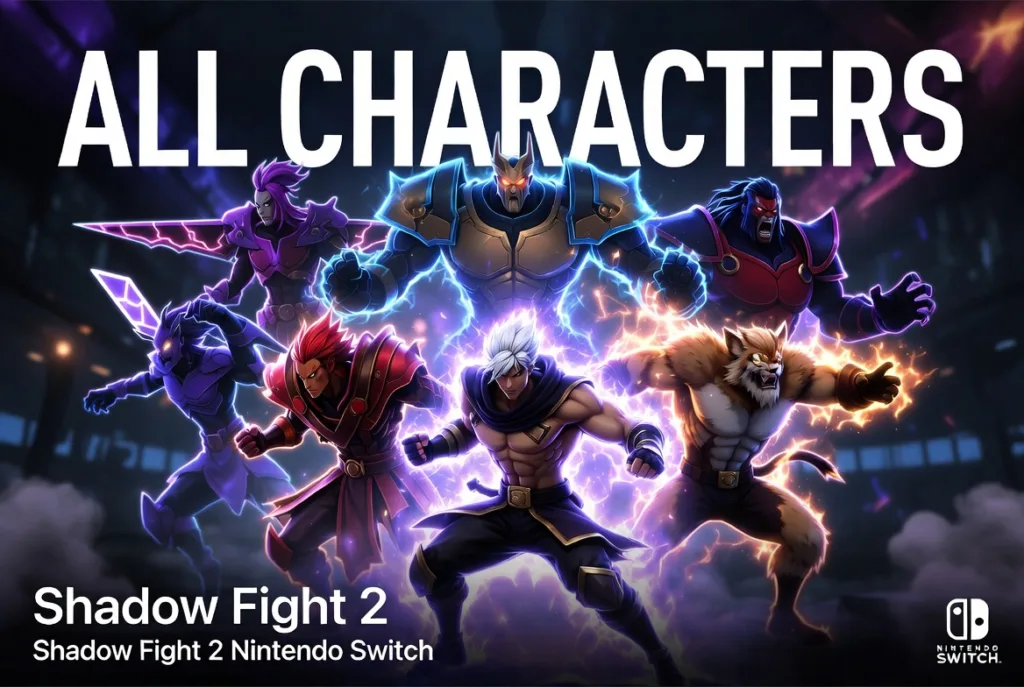
Shadow Fight 2 is one of the most beloved mobile fighting games ever made. It blends deep combat mechanics with a compelling story, and the Nintendo Switch version brings the full experience to a handheld console. Whether you’re a returning fan or picking it up for the first time, understanding every character in the game gives you a real advantage.
This guide covers every major character you’ll face across the game’s seven acts, the Interlude, the Old Wounds chapter, and the Special Edition content. From the very first boss you meet to the fearsome Titan at the end, we’ve got everything you need to know.
By the time you finish reading, you’ll have a full picture of each character’s role, fighting style, difficulty level, and how to beat them. Let’s get into it.
Shadow Fight 2 Nintendo Switch All Characters Overview
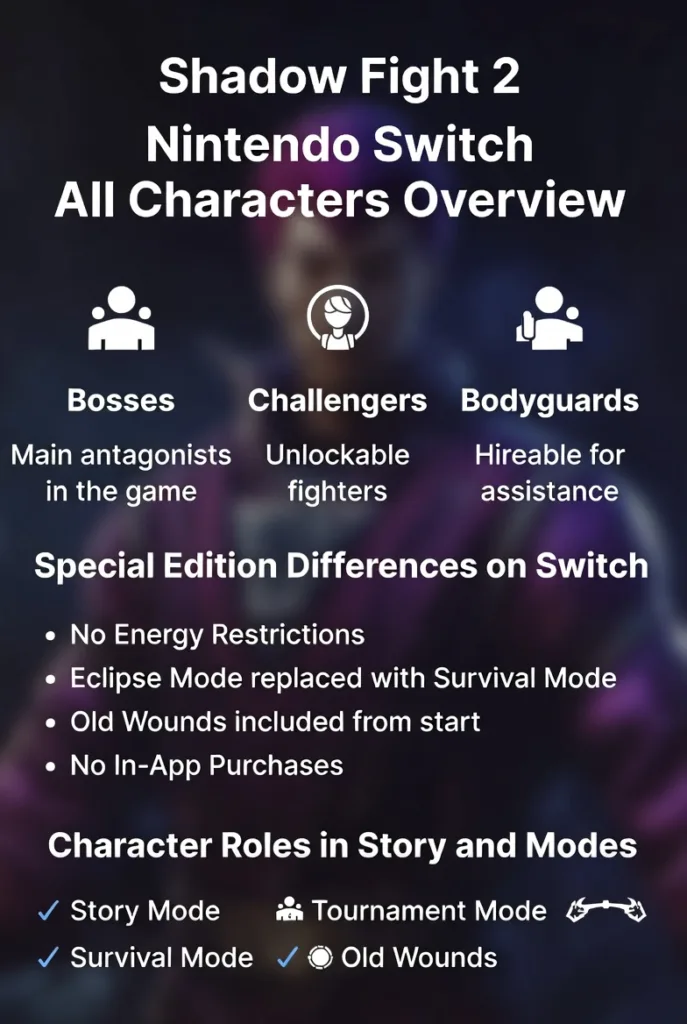
Before diving into individual characters, it helps to understand how they’re organised within the game. Shadow Fight 2 has a structured cast that falls into clear categories, and knowing who does what makes your progression through the game much smoother.
Bosses, Challengers and Fightable Opponents
The game divides its characters into three main groups.
Bosses are the primary antagonists of each Act. They’re waiting behind sealed gates, and you fight them to unlock the next stage of the story. Each boss has a unique weapon, fighting style, and set of bodyguards.
Challengers are optional opponents who appear throughout each Act. You don’t have to fight them to progress, but beating them rewards you with weapons, coins, and experience. They appear at set points and represent the mid-tier challenge in any given Act.
Bodyguards are the regular fighters that accompany each boss. You face them in waves during boss encounters. They share similar gear and move sets to their bosses, which makes them useful for practice.
Special Edition Differences on Switch
The Shadow Fight 2 Nintendo Switch version includes the Special Edition, which makes some meaningful changes compared to the original mobile release.
- There are no energy restrictions. On mobile, your energy bar limits how much you can play. On Switch, you can fight as much as you want.
- Eclipse mode has been replaced. Eclipse was a premium difficulty mode on mobile. On Switch SE, this content is handled differently — more on that in the unlocking section below.
- The Old Wounds chapter is included from the start. This is a prequel chapter that expands the lore and adds extra characters to fight.
- All in-app purchases from the mobile version are gone. Everything is accessible through standard gameplay.
These changes make the Switch version a much cleaner and more complete experience.
Character Roles in Story and Modes
Every character in Shadow Fight 2 serves a narrative function. The bosses represent the demons that Shadow (the protagonist) accidentally unleashed by opening the Gates of Shadows. The Challengers represent skilled fighters who cross your path for their own reasons. The Interlude characters connect the main story arcs, and Titan stands as the true final antagonist.
In terms of game modes, characters also appear in:
- Story Mode – The main campaign through Acts I–VII plus the Interlude
- Tournament Mode – Random opponents drawn from the game’s roster
- Survival Mode – Waves of enemies that include fighter types from each Act
- Old Wounds – A standalone chapter with its own character encounters
Complete List of All Main Story Bosses
Each Act has one main boss. They are powerful, well-designed fighters with distinct personalities and fighting styles. Here is a full breakdown of every story boss in Shadow Fight 2.
Act I – Lynx the Agile Demon
Lynx is the first boss you face, and he sets the tone for the whole game. He’s a fast, aggressive fighter who uses claws as his primary weapon. Don’t let his position as the opening boss fool you — he’s deceptively tricky, especially for new players.
His fighting style relies on quick lunges and close-range pressure. He’ll get in your face and stay there, mixing light attacks with sudden grabs. He telegraphs his moves slightly, but his speed makes it hard to react in time until you’re used to the rhythm.
Key details:
| Detail | Info |
|---|---|
| Weapon | Claws |
| Fighting Style | Aggressive, close-range |
| Act | I |
| Difficulty | Low–Medium |
| Reward | Claws weapon unlock |
Lynx also has a bodyguard team that includes fighters using similar claw-based techniques. Beating them before the boss fight gives you a good read on how claw attacks work.
Act II – Hermit (Wolverine Master)
Hermit is the second boss and a significant step up in challenge. He’s an older warrior who fights with shurikens and a staff, and his style blends long-range projectile attacks with strong close-quarters strikes.
What makes Hermit unique is his unpredictability. He switches between ranged and melee fluidly, which forces you to be ready for either at any moment. New players often get caught chasing him, only to get hit by a sudden staff swing.
Key details:
| Detail | Info |
|---|---|
| Weapon | Shurikens / Staff |
| Fighting Style | Balanced, mid-to-long range |
| Act | II |
| Difficulty | Medium |
| Reward | Shuriken weapon type |
The fight with Hermit is where many players first start to appreciate the importance of perk selection and proper gear level matching.
Act III – Butcher the Berserker
Butcher is the definition of brute force. He wields dual swords and fights with reckless aggression, charging forward with powerful combos designed to overwhelm you before you can find your footing.
He hits hard and fast. His attacks deal significant damage, and he doesn’t rely on finesse — he just hammers you until something gives. The key to this fight is patience. Let him come to you, dodge cleanly, and punish the gaps in his combos.
Key details:
| Detail | Info |
|---|---|
| Weapon | Dual Swords |
| Fighting Style | Aggressive berserker |
| Act | III |
| Difficulty | Medium–High |
| Reward | Dual swords unlock |
Butcher’s bodyguards are also notably aggressive, which makes the approach to his fight one of the more exhausting in the early game.
Act IV – Wasp the Pirate Queen
Wasp is one of the most interesting characters in the game, both in design and combat style. She uses nunchaku and fights with a fluid, dance-like style that makes her timing incredibly hard to read.
She mixes fast combo strings with evasive footwork, and she has a habit of sliding in and out of range. You’ll find yourself swinging at air more than once. The trick is to stay patient, bait her in, and use heavier weapons that interrupt her combo strings.
Key details:
| Detail | Info |
|---|---|
| Weapon | Nunchaku |
| Fighting Style | Fast, evasive |
| Act | IV |
| Difficulty | High |
| Reward | Nunchaku weapon type |
Wasp is widely considered one of the toughest bosses in the first half of the game, particularly because her attack patterns don’t have obvious tells.
Act V – Widow the Healer
Widow is a healer-type character who fights with meteor hammer. What makes her dangerous isn’t just her damage output — it’s her ability to use healing magic during the fight. If you don’t deal enough pressure, she’ll restore health mid-battle, effectively undoing your progress.
This fight rewards aggression more than most others. You want to keep her on the back foot and not give her room to breathe. A combination of fast weapons and movement-disrupting perks works well here.
Key details:
| Detail | Info |
|---|---|
| Weapon | Meteor Hammer |
| Fighting Style | Defensive, healing abilities |
| Act | V |
| Difficulty | High |
| Reward | Meteor hammer access |
Widow’s design is one of the most memorable in the game. Her combination of mystical aesthetic and practical healing mechanic makes her fight feel genuinely different from what came before.
Act VI – Monkey the Acrobat
Monkey is fast, unpredictable, and genuinely chaotic. He uses staff and brings an acrobatic fighting style full of flips, aerial attacks, and misdirection. His move set is the most varied of any boss, and he can switch directions mid-combo in ways that few other characters can.
He’s also surprisingly strong for how mobile he is. His aerial attacks hit harder than they look, and his staff gives him excellent reach. Keeping a level head and not chasing him is the most effective approach.
Key details:
| Detail | Info |
|---|---|
| Weapon | Staff |
| Fighting Style | Acrobatic, aerial-based |
| Act | VI |
| Difficulty | Very High |
| Reward | Staff mastery upgrades |
Monkey is often cited by experienced players as the hardest boss to adapt to on a first playthrough, simply because nothing else in the game prepares you for how erratic he is.
Act VII – Gecko the Assassin
Gecko is the final boss of the main story before the Interlude. He’s a calculating, precise fighter who uses sai and relies on counter-attacks and patience rather than aggression. He tends to wait for you to make a mistake and then punish it hard.
His fighting style rewards players who are also disciplined. If you go in swinging wildly, he’ll destroy you. But if you play methodically and wait for clean openings, he becomes manageable.
Key details:
| Detail | Info |
|---|---|
| Weapon | Sai |
| Fighting Style | Counter-based, precise |
| Act | VII |
| Difficulty | Very High |
| Reward | Final Act completion rewards |
Gecko feels like a test of everything you’ve learned. His deliberate, reactive style means that only players who’ve genuinely mastered the combat engine will find this fight straightforward.
Interlude – Shogun and Titan
The Interlude is the bridge between the main story and the true ending. It introduces two of the most significant characters in the entire game.
Shogun is a powerful warlord who uses a composite sword and fights with a formal, disciplined style. He’s faster and more dangerous than any boss in the main Acts. He serves as a penultimate challenge and represents what the game’s combat system looks like at its highest level.
Titan is the true final boss. He is the entity that possesses Shadow and drives the core conflict of the story. He uses a titan sword and moves with terrifying power and speed. His health pool is massive, and his damage output is punishing. This fight is designed to push your build, your reflexes, and your gear to the absolute limit.
Key details:
| Character | Weapon | Role | Difficulty |
|---|---|---|---|
| Shogun | Composite Sword | Penultimate Boss | Extreme |
| Titan | Titan Sword | Final Boss | Extreme |
Beating Titan marks the completion of Shadow’s story and is one of the most satisfying moments the game offers.
Old Wounds Sensei Chapter Characters
The Old Wounds chapter is a prequel included in the Special Edition. It tells the story of events that took place before the main game, giving context to Shadow’s origins and the nature of the Gates of Shadows.
Prince and Ancient Foes
The main new character introduced in Old Wounds is the Prince, a young warrior with a direct, powerful fighting style. He serves as both a guide and an opponent in this chapter. His encounters are well-balanced and feel fresh compared to what you’ve experienced in the main game.
The chapter also introduces several ancient foes — fighters from Shadow’s past who helped shape who he became. These encounters are lore-rich and often reveal details about the world that the main game only hints at.
Revisits – Lynx, Hermit, Butcher, Wasp, Widow, Shogun
Old Wounds also revisits several major bosses from the main game in their earlier forms. You’ll face:
- Lynx – Encountered at an earlier point in his story
- Hermit – Seen before his full transformation into the recluse you know
- Butcher – A younger, equally brutal version of the berserker
- Wasp – Before becoming the pirate queen, still dangerous
- Widow – Shown with more of her healing lore on display
- Shogun – A contextual encounter that deepens his role in the world
These revisits are not just copy-paste fights. The context is different, the narrative framing is different, and in some cases, the fights themselves have adjusted difficulty and mechanics to reflect the prequel timeline.
All Challengers by Act Guide
Challengers are optional but valuable. They drop weapons, offer bonus coins, and give you a way to grind experience in between boss attempts. Here’s a full guide to every major challenger across all Acts.
Act I – Trickster (Nunchaku Fighter)
Trickster is the first challenger you encounter. He uses nunchaku and fights with a deceptive style that mixes quick attacks with feints. He’s designed to introduce you to the concept of reading opponent movement without the full pressure of a boss fight.
His reward is a set of nunchaku gear and a decent coin payout. He’s easy enough to beat once you’ve got a basic feel for the combat.
Act II – Hawk (Naginata Warrior)
Hawk uses a naginata, a long-reach polearm that gives him a significant range advantage. He relies on keeping distance and poking at you with extended attacks. Getting inside his range is the key to beating him efficiently.
His weapon drops make this fight especially worth doing, as naginata-type weapons are strong in the mid-game.
Act III – Rose (Katana Duelist)
Rose is a skilled sword fighter who uses a katana with technical precision. She’s one of the more balanced challengers in the game, mixing offence and defence in a way that makes her feel like a mini-boss rather than a casual challenge.
Her drops include katana gear, and her fight is genuinely enjoyable — one of the better-designed challenger encounters in the game.
Act IV – Fisher (Staff User)
Fisher is a grounded, practical fighter who uses a staff. He’s not flashy, but he’s consistent and hard to punish because he plays defensively. Patience is your best tool here — bait him forward and then respond to his extended attacks with clean counters.
Act V – Outcast (Kusarigama Expert)
Outcast is a fascinating challenger. The kusarigama is one of the more unusual weapons in the game — a sickle-and-chain combination that creates strange range dynamics. He can attack from unexpected angles, which makes this fight a genuine test of your adaptability.
His weapon drops are also some of the most useful you can get at this stage of the game.
Act VI – Ronin (Dadao Master)
Ronin is a heavy hitter. The dadao is a large, powerful sword, and Ronin swings it with authority. He’s slower than most challengers, but each hit he lands is significant. The key is exploiting the recovery time after his swings without getting clipped.
Interlude – Nova (Knuckles Brawler)
Nova is the Interlude’s challenger and one of the most memorable non-boss characters in the game. She fights bare-handed with knuckles and brings a brawling, high-pressure style that feels completely different from anything you’ve faced before.
She’s fast, aggressive, and doesn’t give you much room. She also has unique perks that make her more resilient than her challenger status might suggest. Many players consider her harder than some of the main bosses.
| Challenger | Act | Weapon | Difficulty |
|---|---|---|---|
| Trickster | I | Nunchaku | Easy |
| Hawk | II | Naginata | Easy–Medium |
| Rose | III | Katana | Medium |
| Fisher | IV | Staff | Medium |
| Outcast | V | Kusarigama | Medium–High |
| Ronin | VI | Dadao | High |
| Nova | Interlude | Knuckles | Very High |
Characters Tier List by Difficulty
Understanding where each character sits in terms of difficulty helps you plan your progression and know when to grind more before attempting a fight.
Easiest to Hardest Bosses Ranking
| Rank | Boss | Act | Difficulty Rating |
|---|---|---|---|
| 1 (Easiest) | Lynx | I | ★★☆☆☆ |
| 2 | Hermit | II | ★★★☆☆ |
| 3 | Butcher | III | ★★★☆☆ |
| 4 | Widow | V | ★★★★☆ |
| 5 | Wasp | IV | ★★★★☆ |
| 6 | Gecko | VII | ★★★★☆ |
| 7 | Monkey | VI | ★★★★★ |
| 8 | Shogun | Interlude | ★★★★★ |
| 9 (Hardest) | Titan | Interlude | ★★★★★ |
Note that this ranking reflects general player experience. Your personal difficulty may vary depending on your gear level and which perks you’re running. Some players find Wasp harder than Monkey, and Widow is often underrated because of her healing mechanic.
Top Challengers for Weapon Unlocks
If your goal is farming weapon unlocks and gear, some challengers are more efficient than others. Here are the best ones to prioritise:
| Challenger | Best Drop | Why Farm It |
|---|---|---|
| Rose (Act III) | Katana set | Strong mid-game weapon |
| Outcast (Act V) | Kusarigama | Unique attack angles |
| Hawk (Act II) | Naginata | Great range weapon early |
| Nova (Interlude) | Knuckles | Fastest attack speed in game |
Farming challengers also builds your coin reserves quickly, which lets you upgrade gear more consistently before boss fights.
Strategies to Defeat All Characters
Knowing a character exists is one thing. Knowing how to beat them is another. Here’s a practical breakdown of the best strategies for tackling the toughest characters in the game.
Best Weapons, Perks and Loadouts
Your loadout matters enormously in Shadow Fight 2. The game isn’t just about reflexes — it’s about preparation. Here are the most effective weapon and perk combinations for the late-game challenges:
For fast bosses (Wasp, Monkey, Nova): Use heavy weapons with wide swing arcs. Dadao and composite sword work well because their range stops fast opponents from getting inside your guard. Pair with Bleeding or Poisoning perks to add damage over time, which helps when you can’t land hits consistently.
For counter-heavy bosses (Gecko, Shogun): Use fast weapons with low recovery time. Sai or nunchaku work well because you can attack and recover before they respond. Pair with Lifesteal perks to sustain health during prolonged fights.
For tanky bosses (Titan, Butcher): Maximise damage output. The heaviest weapons with Critical Hit and Damage Boost perks will shorten the fight significantly. Against Titan specifically, bringing your highest-rated gear regardless of type is essential.
Recommended magic loadouts:
| Situation | Magic Type | Effect |
|---|---|---|
| Fast opponents | Slow | Reduces opponent speed |
| Healing opponents (Widow) | Stun | Interrupts heal animations |
| High damage opponents | Shield | Blocks burst damage |
| Sustained fights | Lifesteal | Recovers health during combat |
Weaknesses, Movesets and Patterns
Every boss in Shadow Fight 2 has exploitable patterns. Here’s a quick reference for the most important ones:
Lynx – Baits forward attacks. Wait for him to lunge and side-step. Punish his recovery frame.
Hermit – Hates close-range pressure. Get inside his projectile range and keep him there. He switches to staff when crowded, which is easier to read.
Butcher – Leaves himself open after a three-hit combo. Count his strikes and attack on the fourth beat.
Wasp – Struggles against heavy weapons that interrupt her combos. Use low kicks to catch her mid-slide.
Widow – Rush her whenever she raises her hand to heal. The heal animation is the tell. Interrupt it every time.
Monkey – Don’t chase him into the air. Let him land, then attack immediately. His air combos are dangerous, but his landing frames are vulnerable.
Gecko – Attack then reset your position. Don’t stay in place — he punishes static fighters heavily. Keep him guessing by mixing attack distances.
Shogun – Respect his range and don’t rush. His composite sword has exceptional range. Stay just outside it, bait the overextended swing, then close in.
Titan – This fight is a war of attrition. Use your strongest gear, bring sustain magic, and expect it to take multiple attempts until you learn his full pattern set.
Unlocking and Refighting Characters
After beating a boss or challenger, you may want to return to fight them again — for loot, practice, or just the enjoyment of the fight.
Eclipse Alternatives in Switch SE
On the original mobile version, Eclipse mode offered a harder version of the game with unique rewards. In the Special Edition on Nintendo Switch, this mechanic is replaced. Instead, the game provides access to harder variants of story content through the Survival and Tournament modes, which generate tougher versions of the game’s fighters at higher stages.
To access the hardest content the Switch version offers, you’ll want to progress through Act VII and into the Interlude, then focus on grinding Tournament mode at its higher tiers.
If you want to refight specific bosses, the game allows you to return to previous Acts after completing them. The challenge scales slightly, and loot drops are randomised, making revisits worthwhile even after you’ve cleared the story.
Tournament and Survival Tips
These are the two modes where you can repeatedly encounter the game’s character roster in different combinations.
Tournament Mode:
- Fight opponents drawn from the current Act’s pool
- Rewards are weighted towards the weapons and gear of that Act
- Competing regularly helps with both coin income and gear variety
- The final rounds feature opponents close to boss difficulty
Survival Mode:
- Continuous waves of opponents without rest between fights
- Health doesn’t reset between rounds — you carry your current health forward
- Use Lifesteal builds here, as they let you recover health through the fights themselves
- Late waves pull from the hardest characters in the game’s roster
General tips for both modes:
- Set your best gear before entering — you can’t change loadouts mid-run
- Prioritise survivability perks over pure damage in Survival
- In Tournament, damage output wins faster — shorter fights preserve your health better
- Watch for the Act VIII opponents in high-level Tournaments — they preview the hardest fighter types in the game
FAQs
How many bosses are in Shadow Fight 2 on Nintendo Switch?
There are nine main bosses across the standard game — one per Act (Acts I–VII), plus Shogun and Titan in the Interlude. The Old Wounds chapter adds revisits of previously fought bosses plus the Prince.
Is the Nintendo Switch version of Shadow Fight 2 different from mobile?
Yes. The Switch Special Edition removes energy restrictions and in-app purchases, includes the Old Wounds chapter, and replaces Eclipse mode with alternate challenge content. It’s widely considered the definitive version of the game.
What is the hardest boss in Shadow Fight 2?
Titan is the hardest boss in terms of health and damage output. However, many players consider Monkey (Act VI) and Shogun (Interlude) to be harder in terms of pure technique required.
Can you refight bosses in Shadow Fight 2 on Switch?
Yes. After clearing an Act, you can return to it and refight bosses for loot and coins. Difficulty scales slightly, and rewards are randomised.
Who is Nova in Shadow Fight 2?
Nova is the Interlude challenger. She fights with knuckles and has one of the fastest and most aggressive styles in the game. She’s optional but rewards some of the most useful gear available.
What weapons do you unlock by beating challengers?
Each challenger drops gear themed around their own weapon type. Rose drops katana gear, Outcast drops kusarigama gear, and Nova drops knuckles-based equipment.
Is Old Wounds included in Shadow Fight 2 on Nintendo Switch?
Yes. The Old Wounds Sensei chapter is included in the Special Edition and available from the start. It acts as a prequel to the main story and features its own set of characters and encounters.
What is the best loadout for beating Titan?
Bring your highest-rated weapon regardless of type, pair it with Critical Hit and Damage Boost perks, and use Shield or Lifesteal magic. Titan’s fight is about sustaining pressure without taking catastrophic damage.
About The Author
